A quarterly deep clean cannot replace a weekly cleaning schedule, yet plenty of Tulsa facility managers budget as if it can. The thinking usually goes one of two ways: either a deep clean is “just regular cleaning done slower,” so it should cover everything, or a big periodic clean is thorough enough that the weekly visits are optional. Both ideas break down the moment you look at what each service is actually built to do. The difference between deep cleaning and regular cleaning is not speed or effort. It is scope, frequency, and purpose, and once those three things are clear, it becomes obvious why an office needs both on separate schedules. This post walks through what each one covers, how they compare side by side, and how to fit both into a building plan in Tulsa, Oklahoma.
What Is the Difference Between Deep Cleaning and Regular Cleaning?
Regular cleaning is the routine work that keeps a building presentable and hygienic from one day to the next. It happens on a fixed cadence, daily or weekly for most offices, and it focuses on the surfaces and spaces people touch and see: desks, floors, restrooms, kitchens, entrances, and trash. Deep cleaning is a periodic reset. It goes after the buildup that routine visits are not scoped to handle, such as carpet extraction, blinds, baseboards, behind and under furniture, vents, grout, break-room appliance interiors, and high dusting. Most commercial buildings schedule it quarterly to twice a year.
One useful way to see the split is the distinction the CDC draws between cleaning versus disinfecting. Cleaning with soap or detergent, water, and scrubbing physically removes dirt and germs from a surface. Disinfecting uses chemicals to kill the germs that remain, and the CDC is clear that surfaces should be cleaned before they are disinfected. Regular cleaning delivers both steps on high-traffic surfaces every visit. Deep cleaning applies the same principle to areas that only get reached a few times a year, which is exactly why it cannot substitute for the weekly work. A restroom fixture that gets sanitized once a quarter is not a clean restroom fixture.
What Regular Cleaning Covers Each Week
Regular cleaning exists to meet a baseline that never goes away. OSHA’s general industry rule on walking-working surfaces, 29 CFR 1910.22, requires that all places of employment be kept “in a clean, orderly, and sanitary condition,” and the OSHA housekeeping standard is not something a building meets once and then forgets about. It is met by repetition. The tasks are familiar because they are the same every visit: dusting, vacuuming, wiping surfaces, restroom sanitizing, and trash. For a typical Tulsa office that means entrances, private offices, conference rooms, kitchens, restrooms, and open workspaces get attention on a schedule that matches how hard each area is used.
The CDC’s facility guidance reinforces the same idea from a health standpoint. It recommends cleaning high-touch surfaces such as door handles, elevator buttons, restroom fixtures, and desks regularly, and disinfecting where someone has been ill. None of that can wait for a quarterly visit. The purpose of routine cleaning is to maintain daily appearance and hygiene, and the frequency follows from that purpose. When a company lists its commercial cleaning services, the weekly items are the core of the agreement, and everything else is layered on top.
What Deep Cleaning Adds and Why It Matters
Deep cleaning targets what routine work skips by design. A weekly visit is scoped for surfaces at eye level and floor level in occupied areas, because that is where the visible dirt and the daily germ load live. Over months, though, dust settles on top of cabinets, ductwork, and light fixtures. Carpets hold soil that vacuuming does not lift. Grout darkens, blinds collect film, and the inside of the break-room refrigerator becomes a project nobody wants to own. The EPA’s guide to office indoor air quality notes that the fine particles you cannot see are more harmful than the ones you can, that trash should be emptied daily, and that water spills should be cleaned up promptly to prevent mold. Daily trash and prompt spill cleanup belong to the routine. Reaching the fine particles that have settled into carpet fibers and on high surfaces is the periodic job.
A commercial deep clean in a Tulsa office typically includes the following work, none of which is part of a standard weekly scope:
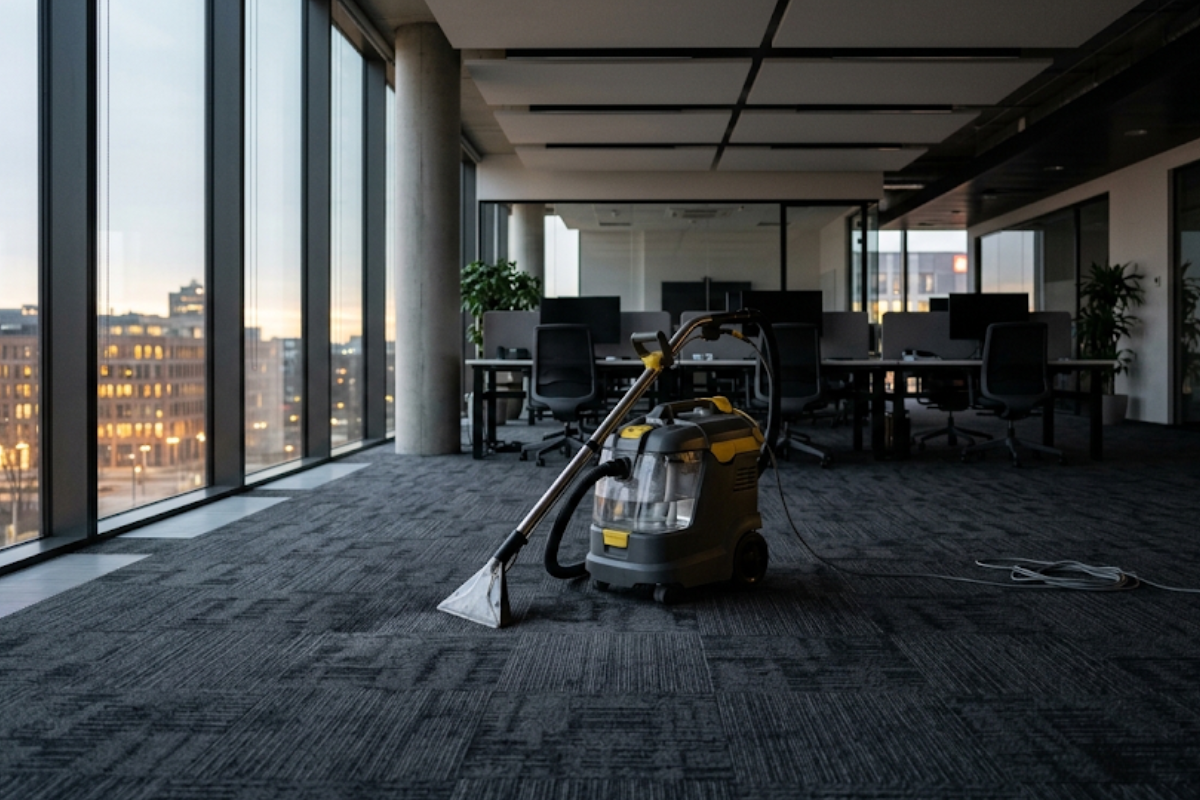
- Carpet extraction with hot water and a truck-mount or portable extractor, which pulls out embedded soil that vacuuming leaves behind. This is usually scheduled after hours so the carpet can dry before staff return.
- High dusting of vents, ceiling fixtures, tops of cabinets, and door frames. This is where the settled particulate that the EPA describes collects between visits.
- Blinds, baseboards, and window sills wiped or washed by hand, since these surfaces are rarely touched during a routine pass.
- Moving desks, chairs, and filing cabinets to clean behind and under furniture, then putting everything back where it belongs.
- Grout scrubbing in restrooms and kitchens, plus break-room appliance interiors such as refrigerators and microwaves.
Because these tasks add hours to a visit, they are priced and scheduled separately. That is also why deep cleaning is typically scheduled quarterly to twice a year rather than folded into every week.
Regular Cleaning vs Deep Cleaning: A Side-by-Side Comparison
The clearest way to understand the difference between deep cleaning and regular cleaning is to line up the two services across the same five questions: how often, why, what, how long, and who asks for it. Regular cleaning happens daily or weekly. Its purpose is to maintain daily appearance and hygiene. The typical tasks are dusting, vacuuming, wiping surfaces, restroom sanitizing, and trash. The time involved is shorter visits on a fixed schedule, and the scope is set once in the service agreement. Deep cleaning happens quarterly to twice a year. Its purpose is to reset the building and reach what routine work skips. The typical tasks are carpet extraction, blinds, baseboards, behind and under furniture, vents, grout, break-room appliance interiors, and high dusting. The time involved is longer visits, usually after hours or on a weekend, and it is scheduled in advance by the facility manager, often around an event or a season change.
Time is the row people underestimate. ISSA publishes production rates that show how quickly routine work moves when it is done right: mopping 1,000 square feet with a 14-inch flat mop takes about 11.2 minutes, and restrooms run about 3 minutes per fixture, according to their guide to cleaning times. Those numbers only hold for surfaces that get regular attention. Deep-clean tasks have no comparable pace because moving furniture, extracting carpet, and hand-wiping blinds are slow by nature.
| Comparison | Regular Cleaning | Deep Cleaning |
|---|---|---|
| Frequency | Daily or weekly | Quarterly to twice a year |
| Purpose | Maintain daily appearance and hygiene | Reset the building and reach what routine work skips |
| Typical tasks | Dusting, vacuuming, wiping surfaces, restroom sanitizing, and trash | Carpet extraction, blinds, baseboards, behind and under furniture, vents, grout, break-room appliance interiors, and high dusting |
| Time | Shorter visits on a fixed schedule | Longer visits, usually after hours or on a weekend |
| Who requests it | Set once in the service agreement | Scheduled in advance by the facility manager, often around an event or a season change |
The takeaway is simple: the two services answer different questions, so neither one makes the other unnecessary.
How to Schedule Both in a Tulsa Office
The practical approach is to treat regular cleaning as the fixed base and deep cleaning as a planned layer on top of it. Start by matching the routine frequency to how the building is used. A single-tenant office with light foot traffic may hold up well on a few visits per week, while a medical office, a school, or a bank branch with a steady stream of visitors usually needs daily attention to restrooms, lobbies, and high-touch surfaces. Once that base is in place, put deep cleaning on the calendar rather than waiting for someone to complain about the carpet. Many Tulsa offices tie it to natural breaks: the week between Christmas and New Year, the end of spring pollen season, or the days before a large client visit or open house.
It also helps to think about what staff do between visits, because a building that stays tidy from one cleaning to the next needs fewer emergency deep cleans. Simple habits such as clearing desks, wiping up kitchen spills the same day, and keeping walkways clear extend the life of both services, and there are more ideas on that topic in our post on keeping an office clean between cleanings. If you are not sure where your building’s routine scope should end and its periodic scope should begin, the easiest first step is to contact Premier Janitorial and request a Free Facility Assessment, which is a walkthrough built to answer exactly that question.
Why Choose Premier Janitorial for Deep and Regular Cleaning in Tulsa
Separating routine scope from deep-cleaning scope is the first thing that happens during Premier Janitorial’s Free Facility Assessment walkthrough. Walking the building room by room, we note which surfaces need attention every visit and which ones are periodic projects, so a Tulsa office ends up with a written weekly scope and a separate list of what gets layered in quarterly or twice a year. That distinction changes by facility type. For churches, that means routine weekly maintenance alongside deep cleaning for special events, so a sanctuary that is cleaned each week can still be reset before a holiday service or a wedding. For medical offices, disinfection of high-touch surfaces in waiting areas and exam rooms is part of the routine rather than something saved for a periodic visit. Offices, schools, banks, and managed properties across Tulsa, Broken Arrow, Bixby, Jenks, Owasso, and Sand Springs get the same two-list approach, so the difference between deep cleaning and regular cleaning is settled on paper before the first visit rather than argued about later.
Conclusion
The difference between deep cleaning and regular cleaning comes down to scope, frequency, and purpose. Regular cleaning runs daily or weekly to maintain appearance and hygiene on the surfaces people use every day. Deep cleaning runs quarterly to twice a year to reach the carpet, vents, blinds, grout, and hidden corners that a routine visit is not built to handle. One is the base, the other is the reset, and a Tulsa, Oklahoma office that tries to run on only one of them ends up either paying for work it does not need or living with buildup it cannot see. Put the weekly scope in writing, put the deep cleans on the calendar, and revisit both whenever the building’s use changes.
Request a Free Facility Assessment for Your Tulsa Building. Contact Premier Janitorial to schedule a walkthrough and get a clear weekly scope and deep-cleaning plan for your facility.
Frequently Asked Questions
What is the difference between deep cleaning and regular cleaning?
Regular cleaning is routine maintenance done daily or weekly to keep a building presentable and hygienic: dusting, vacuuming, wiping surfaces, restroom sanitizing, and trash. Deep cleaning is a periodic, more intensive service that reaches areas routine visits skip, such as carpet extraction, vents, baseboards, blinds, grout, and behind furniture. The two differ in scope, frequency, and purpose rather than effort.
What is included in a deep clean?
A commercial deep clean typically includes carpet extraction, high dusting of vents and fixtures, wiping blinds and baseboards, cleaning behind and under furniture, scrubbing grout, and cleaning break-room appliance interiors. Exact scope depends on the building and how long it has been since the last one.
How often should you deep clean your office?
Most offices schedule a deep clean quarterly to twice a year. Buildings with heavy foot traffic, carpeted floors, or a lot of public visitors tend toward the quarterly end. Lighter-use spaces can often go six months between deep cleans if routine cleaning continues.
Can I just get deep cleanings instead of regular cleanings?
No, because deep cleaning does not maintain daily hygiene. High-touch surfaces, restrooms, and trash need attention on a daily or weekly basis, and a quarterly visit cannot cover that gap. Deep cleaning works best as a periodic layer on top of a consistent routine schedule.
How long does a deep cleaning take?
A deep clean takes considerably longer than a routine visit because it involves moving furniture, extracting carpet, and hand-cleaning surfaces that are normally skipped. Most offices schedule it for a full evening or a weekend so carpets can dry before staff return. Square footage and the condition of the space determine the final time.