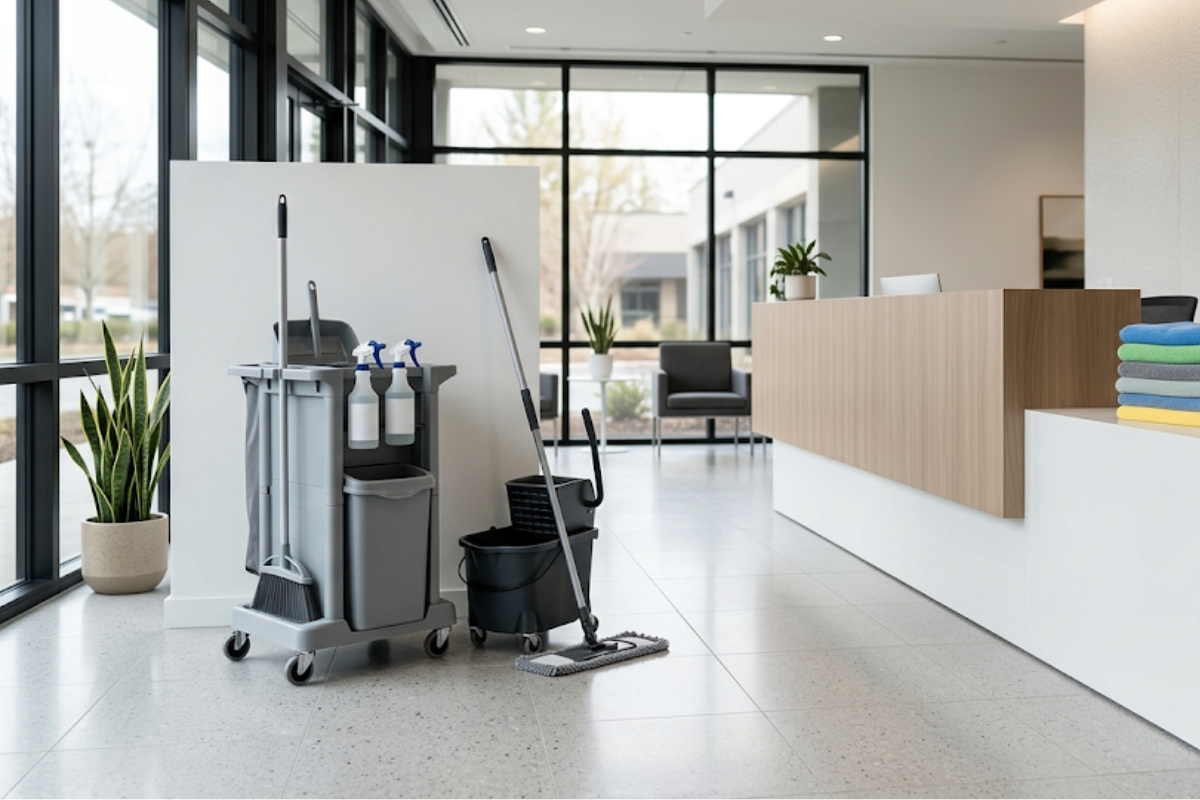
Along Tulsa’s Cherry Street and the office parks off 71st Street, hundreds of small offices, retail strips, and growing businesses currently handle their own after-hours cleaning, usually with whichever employee has ten free minutes before closing. That approach can hold up for a five-desk office, but as square footage, foot traffic, and health expectations grow, the question “is it cheaper to hire a cleaner or do it ourselves” turns into a real budgeting decision instead of a hypothetical one. For business owners in Tulsa, Oklahoma weighing staff time against a fixed monthly service cost, the honest answer depends less on the price of a mop and bucket and more on what DIY cleaning quietly pulls away from the business while it’s happening.
Is It Cheaper to Hire a Cleaner or Do It Ourselves? Breaking Down the Real Costs
The sticker price comparison is deceptively simple. A bottle of glass cleaner and a vacuum look cheap next to a monthly invoice from a cleaning company. But that comparison only counts the supplies, not the labor behind them. According to the U.S. Bureau of Labor Statistics’ Occupational Outlook Handbook, janitorial work carries a measurable median wage nationally, and that figure only reflects base pay, not the payroll taxes, workers’ compensation, and lost productivity that come with assigning the task to an existing employee instead. When a receptionist, teacher, or office manager spends forty-five minutes a day cleaning instead of doing the job they were actually hired for, that time has a cost even if no separate check gets written for it.
Employer cost data tells a similar story from a different angle. The BLS report on total compensation costs shows that wages typically make up roughly seventy percent of what an employer actually spends per hour of labor, with benefits, insurance, and payroll taxes filling out the rest. Businesses that assign cleaning duties to existing staff, or that hire a dedicated part-time cleaner, are absorbing that full compensation cost, not just the hourly wage line on a timesheet. A contracted service, by comparison, folds all of that overhead into one predictable monthly number.
The Hidden Costs of DIY Commercial Cleaning
Three costs tend to hide inside a DIY cleaning arrangement, and none of them show up on a receipt.
The first is labor time. Whether it’s an owner staying late or an employee pulled off their regular duties, that time is coming from somewhere, and it’s rarely tracked as a cleaning expense even though it functions like one. The second is supply and equipment cost. Mops, vacuums, disinfectants, trash liners, and paper products all need to be purchased, stored, and restocked, and someone has to notice when they run low. The third is consistency. Without a dedicated schedule or a trained crew, cleaning quality tends to vary week to week depending on who’s doing it and how busy the business is that day, which is a particular problem for retail entryways, restrooms, and other spaces that see high-traffic use throughout the week.
There’s also a compliance layer that many small businesses overlook. Employees who handle cleaning chemicals as part of their job are covered by OSHA’s hazard communication standard, which requires employers to provide training on chemical hazards, safety data sheets, and proper handling procedures. That training obligation applies whether cleaning is someone’s full-time job or a task tacked onto an existing role, and it’s a responsibility that shifts to the provider once cleaning is outsourced.
What Professional Cleaning Actually Costs, and Covers
Professional cleaning pricing is typically structured around square footage, frequency, and the type of facility being serviced, which is why most providers walk a space before quoting a rate rather than publishing a flat number. The Small Business Administration’s hiring guidance walks through exactly how much is involved in properly employing someone, from classification and payroll setup to required benefits like workers’ compensation and unemployment insurance, all of which a business avoids by contracting the work out instead. Industry pricing standards published by ISSA, the cleaning industry’s trade association, similarly note that labor, benefits, payroll taxes, training, and equipment all factor into what a cleaning service charges, which is why a professional quote often looks higher at first glance than it actually is once the comparison includes everything DIY cleaning would require too.
| Cost Factor | DIY (In-House) | Professional Service |
|---|---|---|
| Labor Time | Staff pulled off core duties; hours vary week to week | Dedicated crew time on a fixed schedule |
| Supplies & Equipment | Recurring purchases, storage, and restocking managed internally | Included as part of the service arrangement |
| Consistency & Quality Control | Varies by who is assigned and how busy the day is | Standardized routine with a set scope of work |
| Liability & Insurance Exposure | Business retains risk for injury or chemical-related incidents | Provider carries its own coverage for cleaning-related work |
| Opportunity Cost of Staff Time | Hours diverted from revenue-generating or core job duties | Staff stay focused on the work they were hired to do |
| Training & Compliance | Employer must provide hazard communication and chemical safety training | Handled by the service provider as part of doing business |
Quick Signs the Math Has Shifted Toward Outsourcing
Not every business needs to make this call the same way, but a few patterns tend to show up right before the DIY approach stops paying off.
- Cleaning tasks are regularly skipped or rushed because staff are busy with their actual jobs.
- Supply costs keep climbing and nobody is tracking what’s being spent monthly.
- Complaints about restrooms, entryways, or common areas are becoming more frequent.
- The business operates in a medical, financial, school, or church setting where consistency and appearance carry extra weight.
- An employee has raised concerns about chemical handling or safety training.
- Leadership can’t say with confidence what cleaning is actually costing the business each month.
Why Choose Premier Janitorial
A flat monthly service cost is easier to plan around than the variable, and often hidden, cost of DIY cleaning. When cleaning is handled internally, the real price shifts every month depending on which employee is available, how much overtime gets paid, and how often supplies need restocking. Premier Janitorial, a family owned company based in Tulsa, Oklahoma, replaces that unpredictability with a set arrangement built around the space itself rather than whoever happens to have free time that week. The categories the company covers, office cleaning, church and religious facility cleaning, school cleaning, medical office cleaning, financial office cleaning, and general commercial and property management cleaning for common areas, restrooms, entryways, retail, and industrial spaces, represent exactly the kind of specialized, ongoing coverage that would otherwise have to be built from scratch in-house, one hire, one training session, and one supply order at a time. For a Tulsa business evaluating a commercial cleaning arrangement, that breadth is less about variety for its own sake and more about not having to reinvent a cleaning program for every type of facility a growing operation might run. Premier Janitorial strives for excellence with professionalism across each of those settings, which matters most in spaces like medical and financial offices where consistency and discretion carry more weight than they would in a typical retail strip.
Making the Decision for Your Tulsa Business
The honest answer to “is it cheaper to hire a cleaner or do it ourselves” isn’t the same for every business, but the calculation almost always looks different once labor time, supplies, consistency, liability, and training are counted alongside the invoice. A five-person office with light foot traffic may genuinely save money handling cleaning internally for now. A growing office, a school, a medical practice, or a property with regular public traffic usually finds that the DIY math stops working once every hidden cost above gets added up honestly.
The Bottom Line
The single most useful rule of thumb is this: if cleaning is starting to compete with payroll hours, supply budgets, or staff attention on a regular basis, it has already stopped being free, even if no invoice says so. Tulsa, OK businesses that take an honest look at labor time, supplies, consistency, and liability side by side usually find the outsourced number is more predictable than the DIY one, even when it looks larger at first glance. The realistic expectation to set is that DIY cleaning rarely stays cheap as a business grows, and the point where it stops paying off is worth identifying before it starts affecting the work everyone was actually hired to do. If that point sounds familiar, reach out to Premier Janitorial for a Free Facility Assessment and get a clear picture of what a fixed, predictable cleaning arrangement would look like for your space.
Ready to See the Real Numbers for Your Facility? Schedule Your Free Facility Assessment and get a straightforward look at what professional cleaning would actually cost for your Tulsa space, with no pressure attached.
Frequently Asked Questions
Is it cheaper to hire a cleaner or do it yourself?
For small spaces cleaned occasionally, doing it yourself can cost less in raw dollars since only supplies are being purchased. For businesses with regular cleaning needs, the labor hours, supply costs, and inconsistent results of DIY cleaning often add up to more than a professional service’s flat rate. The break-even point mostly depends on how much staff time gets diverted and how large the space is.
Is outsourced commercial cleaning cheaper than in-house staff?
Outsourcing is often cheaper once payroll taxes, benefits, supervision, supplies, and equipment are factored in alongside base wages. In-house cleaning can look less expensive on paper because only the hourly wage gets counted, but that rarely reflects the full cost of employing someone. A contracted service is also easier to budget for since the cost is fixed rather than variable.
What hidden costs come with DIY office cleaning?
Hidden costs include the value of employee time spent cleaning instead of doing their primary job, ongoing purchases of supplies and equipment, and the cost of redoing work that wasn’t done to standard. There is also administrative time spent scheduling who cleans what and when, which rarely gets tracked as a real expense.
How much does professional commercial cleaning typically cost?
Commercial cleaning costs vary based on square footage, frequency, and facility type, so pricing is usually quoted after a walkthrough rather than published as a flat rate. Providers weigh labor, supplies, equipment, and scope before offering a number, which is why two businesses of similar size can receive different quotes.
Is hiring a cleaning service worth it for a small business?
For businesses where cleanliness affects customer perception, employee health, or regulatory expectations, a cleaning service is often worth the cost since it delivers consistent, scheduled results without pulling staff off their main duties. Smaller operations with light foot traffic may get by with occasional DIY cleaning, but the calculation tends to shift as the business grows.